 Farm
Rust Plugin Api
Configuring Rust Plugins
Adding Rust plugins by plugins option:
import { defineConfig } from "@farmfe/core";

export default defineConfig({
  // configuring it in plugins
  plugins: [
    ['@farmfe/plugin-sass', { /** plugin options here */ }]
  ],
});
Configuring the Rust plugin package name(or path) in string and its options in object.
Writing Rust Plugin
See Writing Rust Plugins for details.
Plugin Hooks Overview
Farm provides a lot of rollup-style hooks, these hooks are divided into build stage and generate stage:
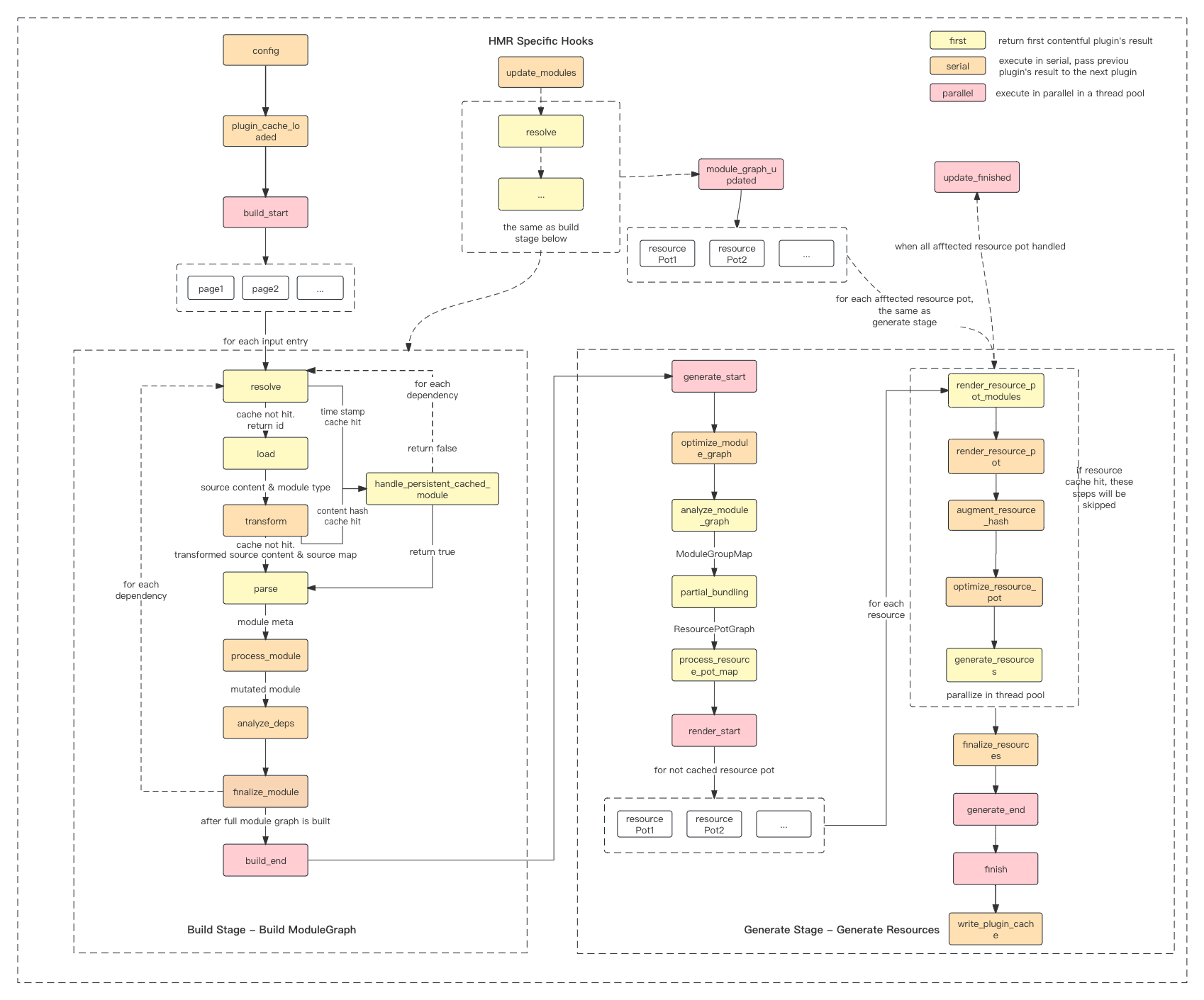
All plugin hooks accept a parameter called CompilationContext. All of the shared compilation info are stored in the context.
There are three kinds of hooks (the same as Rollup):
first: The hooks execute in serial and return immediately when a hook returns a non-null value. (The null means null and undefined in JS, None in Rust).serial: The hooks execute in serial, and every hook's result will pass to the next hook, using the last hook's result as the final result.parallel: The hooks execute in parallel in a thread pool and should be isolated.
name
- required:
true - default:
fn name(&self) -> &str;
Returns the name of this plugin. Example:
impl Plugin for MyPlugin {
  fn name(&self) -> &str {
    "MyPlugin"
  }
}
priority
- required:
false - default:
fn priority(&self) -> i32 {
  100
}
Define the priority of this plugin, the larger the value, the earlier this plugin execute. When plugins has same priority, they will be executed as the same order as the registered order in plugins.
config
- required:
false - hook type:
serial - default:
fn config(&self, _config: &mut Config) -> Result<Option<()>> {
  Ok(None)
}
Modify the config before compilation start in config hook. Refer to Config for definition of Config struct. Example:
impl Plugin for MyPlugin {
  // implement config hook
  fn config(&self, config: &mut Config) -> Result<Option<()>> {
    // set minify to false
    config.input.insert("custom-entry", "./custom.html");
    Ok(Some(()))
  }
}
Note that the Rust Plugin's config hook are called after JS Plugin's config and configResolved hook.
plugin_cache_loaded
- required:
false - hook type:
serial - default:
fn plugin_cache_loaded(
  &self,
  _cache: &Vec<u8>,
  _context: &Arc<CompilationContext>,
) -> Result<Option<()>> {
  Ok(None)
}
Extend persistent cache loading for your plugin.
When Persistent Cache enabled, load and transform hook may be skipped when hitting cache. If your plugin relies on previous compilation result(for example, load a virtual module based on existing modules), you may need to implement this hook to load cached infos of your plugin to ensure cache work as expected.
Example:
#[cache_item]
struct CachedStaticAssets {
  list: Vec<Resource>,
}

impl Plugin for StaticAssetsPlugin {
  fn plugin_cache_loaded(
    &self,
    cache: &Vec<u8>,
    context: &Arc<CompilationContext>,
  ) -> farmfe_core::error::Result<Option<()>> {
    let cached_static_assets: CachedAssets = deserialize!(cache, CachedStaticAssets);

    for asset in cached_static_assets.list {
      if let ResourceOrigin::Module(m) = asset.origin {
        context.emit_file(EmitFileParams {
          resolved_path: m.to_string(),
          name: asset.name,
          content: asset.bytes,
          resource_type: asset.resource_type,
        });
      }
    }

    Ok(Some(()))
  }
}
Note:
deserializeis exposed byfarmfe_core, it can help you deserialize your structs or enums fromVec<u8>.- The cached structs or enums must be rkyv serializable, you can use
#[cache_item]exposed byfarmfe_corecreate a cacheable struct quickly.
build_start
- required:
false - hook type:
parallel - default:
fn build_start(&self, _context: &Arc<CompilationContext>) -> Result<Option<()>> {
  Ok(None)
}
Called before the first compilation starts. You can use this hook to initialize any initial status of your plugins.
resolve
- required:
false - hook type:
first - default:
fn resolve(
  &self,
  _param: &PluginResolveHookParam,
  _context: &Arc<CompilationContext>,
  _hook_context: &PluginHookContext,
) -> Result<Option<PluginResolveHookResult>> {
  Ok(None)
}

/// Parameter of the resolve hook
#[derive(Debug, Clone, Serialize, Deserialize, Hash, PartialEq, Eq)]
#[serde(rename_all = "camelCase")]
pub struct PluginResolveHookParam {
  /// the source would like to resolve, for example, './index'
  pub source: String,
  /// the start location to resolve `specifier`, being [None] if resolving a entry or resolving a hmr update.
  pub importer: Option<ModuleId>,
  /// for example, [ResolveKind::Import] for static import (`import a from './a'`)
  pub kind: ResolveKind,
}

#[derive(Debug, Default, Serialize, Deserialize, Clone)]
#[serde(rename_all = "camelCase", default)]
pub struct PluginResolveHookResult {
  /// resolved path, normally a absolute file path.
  pub resolved_path: String,
  /// whether this module should be external, if true, the module won't present in the final result
  pub external: bool,
  /// whether this module has side effects, affects tree shaking
  pub side_effects: bool,
  /// the query parsed from specifier, for example, query should be `{ inline: "" }` if specifier is `./a.png?inline`
  /// if you custom plugins, your plugin should be responsible for parsing query
  /// if you just want a normal query parsing like the example above, [farmfe_toolkit::resolve::parse_query] should be helpful
  pub query: Vec<(String, String)>,
  /// the meta data passed between plugins and hooks
  pub meta: HashMap<String, String>,
}
Custom source resolving from importer, for example, resolving ./b from a.ts:
import b from './b?raw';
// ...
Then the resolve params would be:
let param = PluginResolveHookParam {
  source: "./b",
  importer: Some(ModuleId { relative_path: "a.ts", query_string: "" }),
  kind: ResolveKind::Import
}
The resolve result of default resolver would be:
let resolve_result = PluginResolveHookResult {
  resolved_path: "/root/b.ts",   // resolved absolute path of the module
  external: false, // this module should be included in the final compiled resources and should not be external
  side_effects: false, // this module may be tree shaken as it does not contains side effects
  query: vec![("raw", "")], // query from the source.
  meta: HashMap::new()
}
The HookContext is used to pass status when you can the hooks recursively, for example, your plugin call context.plugin_driver.resolve in resolve hook:
impl Plugin for MyPlugin {
  fn resolve(
    &self,
    param: &farmfe_core::plugin::PluginResolveHookParam,
    context: &Arc<CompilationContext>,
    hook_context: &PluginHookContext,
  ) -> farmfe_core::error::Result<Option<farmfe_core::plugin::PluginResolveHookResult>> {
    // add a guard to avoid infinite loop
    if let Some(caller) = &hook_context.caller {
      if caller.as_str() == "FarmPluginCss" {
        return Ok(None);
      }
    }

    if matches!(param.kind, ResolveKind::CssAtImport | ResolveKind::CssUrl) {
      // if dep starts with '~', means it's from node_modules.
      // otherwise it's always relative
      let source = if let Some(striped_source) = param.source.strip_suffix('~') {
        striped_source.to_string()
      } else if !param.source.starts_with('.') {
        format!("./{}", param.source)
      } else {
        param.source.clone()
      };

      // call resolve recursively
      return context.plugin_driver.resolve(
        &PluginResolveHookParam {
          source,
          ..param.clone()
        },
        context,
        &PluginHookContext {
          // pass caller we call resolve recursively
          caller: Some("FarmPluginCss".to_string()),
          meta: Default::default(),
        },
      );
    }

    Ok(None)
  }
}
In above example, we call context.plugin_driver.resolve and pass caller as parameter, then we should add a guard like if caller.as_str() == "FarmPluginCss" to avoid infinite loop.
Note:
- By default, you
resolve hookare executed after the default resolver inside Farm, only the sources that can not be resolved by internal resolver will be passed to your plugin, which means if you want to override the default resolve, you need to set your plugin's priority larger than101. - Usually
resolved_pathis the real absolute path that points to a file. But you can still return avirtual module idlikevirtual:my-module, but for virtual module you need to implementloadhook to custom how to load your virtual module. And in Farm,resolved_path + query = module_id. ResolveKindpresents theimport type, Example values:ResolveKind::Require(imported by commonjs require),ResolveKind::CssImport(imported by css's import statement), etc.metacan be shared between plugins and hooks, you can getmetafrom params ofload,transformandparsehooks in any plugin.
load
- required:
false - hook type:
first - default:
fn load(
  &self,
  _param: &PluginLoadHookParam,
  _context: &Arc<CompilationContext>,
  _hook_context: &PluginHookContext,
) -> Result<Option<PluginLoadHookResult>> {
  Ok(None)
}

#[derive(Debug, Clone, Serialize, Deserialize)]
#[serde(rename_all = "camelCase")]
pub struct PluginLoadHookParam<'a> {
  /// the module id string
  pub module_id: String,
  /// the resolved path from resolve hook
  pub resolved_path: &'a str,
  /// the query map
  pub query: Vec<(String, String)>,
  /// the meta data passed between plugins and hooks
  pub meta: HashMap<String, String>,
}


#[derive(Debug, Serialize, Deserialize)]
#[serde(rename_all = "camelCase")]
pub struct PluginLoadHookResult {
  /// the source content of the module
  pub content: String,
  /// the type of the module, for example [ModuleType::Js] stands for a normal javascript file,
  /// usually end with `.js` extension
  pub module_type: ModuleType,
  /// source map of the module
  pub source_map: Option<String>,
}
Custom how to load your module from a resolved module path or module id. For example, load a virtual module:
impl Plugin for MyPlugin {
  fn load(
    &self,
    param: &PluginLoadHookParam,
    _context: &Arc<CompilationContext>,
    _hook_context: &PluginHookContext,
  ) -> Result<Option<PluginLoadHookResult>> {
    // only handle the specified path
    if param.resolved_path == "virtual:my-plugin" {
      return Ok(Some(
        PluginLoadHookResult {
          content: "import real from './real-path';",
          module_type: ModuleType::Js
          source_map: None,
        }
      ))
    }

    Ok(None)
  }
}
module_type and content is required when loading modules in your load hook. source_map is optional, you can return source map if you do transform in the load hook(which is not recommended, we recommend to use transform hook for this situation) or you load original source map from other locations.
transform
- required:
false - hook type:
serial - default:
fn transform(
  &self,
  _param: &PluginTransformHookParam,
  _context: &Arc<CompilationContext>,
) -> Result<Option<PluginTransformHookResult>> {
  Ok(None)
}

#[derive(Debug, Clone, Serialize, Deserialize)]
#[serde(rename_all = "camelCase")]
pub struct PluginTransformHookParam<'a> {
  /// the module id string
  pub module_id: String,
  /// source content after load or transformed result of previous plugin
  pub content: String,
  /// module type after load
  pub module_type: ModuleType,
  /// resolved path from resolve hook
  pub resolved_path: &'a str,
  /// query from resolve hook
  pub query: Vec<(String, String)>,
  /// the meta data passed between plugins and hooks
  pub meta: HashMap<String, String>,
  /// source map chain of previous plugins
  pub source_map_chain: Vec<Arc<String>>,
}


#[derive(Debug, Default, Serialize, Deserialize)]
#[serde(rename_all = "camelCase", default)]
pub struct PluginTransformHookResult {
  /// transformed source content, will be passed to next plugin.
  pub content: String,
  /// you can change the module type after transform.
  pub module_type: Option<ModuleType>,
  /// transformed source map, all plugins' transformed source map will be stored as a source map chain.
  pub source_map: Option<String>,
  /// if true, the previous source map chain will be ignored, and the source map chain will be reset to [source_map] returned by this plugin.
  pub ignore_previous_source_map: bool,
}
Do transformation based on module content and module type. Example for transforming sass to css:
impl Plugin for MyPlugin {
// ignore other code ...
fn transform(
&self,
param: &farmfe_core::plugin::PluginTransformHookParam,
context: &std::sync::Arc<farmfe_core::context::CompilationContext>,
) -> farmfe_core::error::Result<Option<farmfe_core::plugin::PluginTransformHookResult>> {
// module type guard is neccessary
if param.module_type == ModuleType::Custom(String::from("sass")) {
// parse options
const options = parse_options(&self.options, param.module_id);
// compile sass to css
let compile_result = compileSass(¶m.content, options);
return Ok(Some(farmfe_core::plugin::PluginTransformHookResult {
content: compile_result.css,
source_map: compile_result.source_map,
// tell farm compiler that we have transformed this module to css
module_type: Some(farmfe_core::module::ModuleType::Css),
ignore_previous_source_map: false,
}));
}
Ok(None)
}
}
Normal steps for writing transform hook:
- add a
ifguard basedmodule_typeorresolved_pathormodule_id - do transformation of the
content - return the transformed
content,source_mapandmodule_type
For ignore_previous_source_map, if you handled param.source_map_chain and collapsed the source maps of previous plugins in the transform hook. You should set ignore_previous_source_map to true to ensure source map is correct. Otherwise, you should always set this option to false and leave source map chain handled by Farm.
parse
- required:
false - hook type:
first - default:
fn parse(
  &self,
  _param: &PluginParseHookParam,
  _context: &Arc<CompilationContext>,
  _hook_context: &PluginHookContext,
) -> Result<Option<ModuleMetaData>> {
  Ok(None)
}

#[derive(Debug)]
pub struct PluginParseHookParam {
  /// module id
  pub module_id: ModuleId,
  /// resolved path
  pub resolved_path: String,
  /// resolved query
  pub query: Vec<(String, String)>,
  pub module_type: ModuleType,
  /// source content(after transform)
  pub content: Arc<String>,
}


/// Module meta data shared by core plugins through the compilation
/// Meta data which is not shared by core plugins should be stored in [ModuleMetaData::Custom]
#[cache_item]
pub enum ModuleMetaData {
  Script(ScriptModuleMetaData),
  Css(CssModuleMetaData),
  Html(HtmlModuleMetaData),
  Custom(Box<dyn SerializeCustomModuleMetaData>),
}
Parse the transformed module content to ast. Js/Jsx/Ts/Tsx, css and html are supported natively by Farm. Normally you do not need to implement this hook unless you want to support a new module_type other than Js/Jsx/Ts/Tsx, css and html, use ModuleMetaData::Custom for this scenario.
process_module
- required:
false - hook type:
serial - default:
fn process_module(
  &self,
  _param: &mut PluginProcessModuleHookParam,
  _context: &Arc<CompilationContext>,
) -> Result<Option<()>> {
  Ok(None)
}

pub struct PluginProcessModuleHookParam<'a> {
  pub module_id: &'a ModuleId,
  pub module_type: &'a ModuleType,
  pub content: Arc<String>,
  pub meta: &'a mut ModuleMetaData,
}
Do transformation of the parsed result, usually do ast transformation. For example, Farm strip typescript in process_module hook:
impl Plugin for MyPlugin {
   fn process_module(
    &self,
    param: &mut PluginProcessModuleHookParam,
    context: &Arc<CompilationContext>,
  ) -> Result<Option<()>> {
    if !param.module_type.is_script() {
      return Ok(None);
    }
    // strip typescript
    if param.module_type.is_typescript() {
      swc_script_transforms::strip_typescript(param, &cm, context)?;
    }
    // ...ignore other code

    Ok(Some(()))
  }

}
In above example, we ignore non-script modules and strip type annotation of the ast for ts/tsx modules.
analyze_deps
- required:
false - hook type:
serial - default:
fn analyze_deps(
  &self,
  _param: &mut PluginAnalyzeDepsHookParam,
  _context: &Arc<CompilationContext>,
) -> Result<Option<()>> {
  Ok(None)
}

pub struct PluginAnalyzeDepsHookParam<'a> {
  pub module: &'a Module,
  /// analyzed deps from previous plugins, you can push new entries to it for your plugin.
  pub deps: Vec<PluginAnalyzeDepsHookResultEntry>,
}
Analyze dependencies of the module. For example, we have a.ts:
import b from './b';
const c = require('./c');
then normally this hook should push 2 entries to params.deps:
param.deps.push(PluginAnalyzeDepsHookResultEntry {
  source: "./b".to_string(),
  kind: ResolveKind::Import
});
param.deps.push(PluginAnalyzeDepsHookResultEntry {
  source: "./c".to_string(),
  kind: ResolveKind::Require
});
param.deps will be passed to resolve hook later. You can also add new deps that is not related to the ast of your module as you wish, Farm will resolve, load these unrelated modules and add them to the module graph too.
finalize_modules
- required:
false - hook type:
serial - default:
fn finalize_module(
  &self,
  _param: &mut PluginFinalizeModuleHookParam,
  _context: &Arc<CompilationContext>,
) -> Result<Option<()>> {
  Ok(None)
}

pub struct PluginFinalizeModuleHookParam<'a> {
  pub module: &'a mut Module,
  pub deps: &'a Vec<PluginAnalyzeDepsHookResultEntry>,
}
Do any thing you want before seal the module. Note that you can only modify param.module.
build_end
- required:
false - hook type:
parallel - default:
/// The module graph should be constructed and finalized here
fn build_end(&self, _context: &Arc<CompilationContext>) -> Result<Option<()>> {
  Ok(None)
}
Called when all dependencies starting from config.input are handled and ModuleGraph is successfully constructed, you can get the full resolved ModuleGraph here by context.module_graph.
generate_start
- required:
false - hook type:
parallel - default:
fn generate_start(&self, _context: &Arc<CompilationContext>) -> Result<Option<()>> {
  Ok(None)
}
Called before generate stage start.
optimize_module_graph
- required:
false - hook type:
serial - default:
/// Some optimization of the module graph should be performed here, for example, tree shaking
fn optimize_module_graph(
  &self,
  _module_graph: &mut ModuleGraph,
  _context: &Arc<CompilationContext>,
) -> Result<Option<()>> {
  Ok(None)
}
You can do optimization of the module_graph here. For internal plugins, Farm does tree shaking, minification in this hook.
analyze_module_graph
- required:
false - hook type:
first - default:
/// Analyze module group based on module graph
fn analyze_module_graph(
  &self,
  _module_graph: &mut ModuleGraph,
  _context: &Arc<CompilationContext>,
  _hook_context: &PluginHookContext,
) -> Result<Option<ModuleGroupGraph>> {
  Ok(None)
}
Analyze dynamic import of the module_graph, and groups modules based on dynamic import, return the grouped modules.
partial_bundling
- required:
false - hook type:
first - default:
/// partial bundling modules to [Vec<ResourcePot>]
fn partial_bundling(
  &self,
  _modules: &Vec<ModuleId>,
  _context: &Arc<CompilationContext>,
  _hook_context: &PluginHookContext,
) -> Result<Option<Vec<ResourcePot>>> {
  Ok(None)
}

#[cache_item]
#[derive(Debug, Clone, Serialize, Deserialize)]
#[serde(rename_all = "camelCase")]
pub struct ResourcePot {
  pub id: ResourcePotId,
  pub name: String,
  pub resource_pot_type: ResourcePotType,
  modules: HashSet<ModuleId>,
  pub meta: ResourcePotMetaData,
  /// [None] if this [ResourcePot] does not contain entry module.
  /// [Some(entry_id)] otherwise
  pub entry_module: Option<ModuleId>,
  /// the resources generated in this [ResourcePot]
  resources: HashSet<String>,

  /// This field should be filled in partial_bundling_hooks.
  /// the module groups that this [ResourcePot] belongs to.
  /// A [ResourcePot] can belong to multiple module groups.
  pub module_groups: HashSet<ModuleGroupId>,
  pub immutable: bool,
}
Bundle the modules to Vec<ResourcePot> based on module_group_graph and module_graph. A ResourcePot is a structure that Farm uses to hold bundled modules, it will be emitted to final resources in generate_resources hook, you can treat a ResourcePot as Chunk of other tools.
Note:
- This hook will be called in both
first compilation,HMRandLazy Compilation, make sure this hook does not contains side effects(for the same modules, always returns the sameVec<ResourcePot>). - You should set
module.resource_potin this hook.
Refer to the internal implementation of partial bundling in Farm for best practice. Refer to RFC-003 Partial Bundling for how Farm designs bundling.
process_resource_pots
- required:
false - hook type:
serial - default:
/// process resource pots before render and generating each resource
fn process_resource_pots(
  &self,
  _resource_pots: &mut Vec<&mut ResourcePot>,
  _context: &Arc<CompilationContext>,
) -> Result<Option<()>> {
  Ok(None)
}
Do some transformation of the ResourcePots. Note that ResourcePots are not rendered at this time, which means you can not get the rendered code of the Resource Pot, instead, you can only add, remove, transform the modules inside the ResourcePot
render_start
- required:
false - hook type:
serial - default:
fn render_start(
  &self,
  _config: &Config,
  _context: &Arc<CompilationContext>,
) -> Result<Option<()>> {
  Ok(None)
}
Called before resource pots render. After rendering resource pots, executable html, css, js, etc files will be emitted.
render_resource_pot_modules
- required:
false - hook type:
first - default:
fn render_resource_pot_modules(
  &self,
  _resource_pot: &ResourcePot,
  _context: &Arc<CompilationContext>,
  _hook_context: &PluginHookContext,
) -> Result<Option<ResourcePotMetaData>> {
  Ok(None)
}

#[cache_item]
#[derive(Clone, Debug, serde::Serialize, serde::Deserialize)]
pub struct RenderedModule {
  pub id: ModuleId,
  pub rendered_content: Arc<String>,
  pub rendered_map: Option<Arc<String>>,
  pub rendered_length: usize,
  pub original_length: usize,
}

#[cache_item]
#[derive(Clone, Debug, Serialize, Deserialize)]
#[serde(rename_all = "camelCase")]
pub struct ResourcePotMetaData {
  pub rendered_modules: HashMap<ModuleId, RenderedModule>,
  pub rendered_content: Arc<String>,
  pub rendered_map_chain: Vec<Arc<String>>,
  pub custom_data: HashMap<String, String>,
}
Render the given ResourcePot to rendered_content and rendered_source_map_chain. This hook is used to render module's ast to bundled code. If you just want to modify the bundled code, use render_resource_pot instead.
If you really need to use this hook, refer to plugin_runtime for best practice.
render_resource_pot
- required:
false - hook type:
serial - default:
fn render_resource_pot(
  &self,
  _param: &PluginRenderResourcePotHookParam,
  _context: &Arc<CompilationContext>,
) -> Result<Option<PluginRenderResourcePotHookResult>> {
  Ok(None)
}

#[derive(Debug, Clone, Serialize, Deserialize)]
#[serde(rename_all = "camelCase")]
pub struct PluginRenderResourcePotHookParam {
  pub content: Arc<String>,
  pub source_map_chain: Vec<Arc<String>>,
  pub resource_pot_info: ResourcePotInfo,
}

#[derive(Debug, Serialize, Deserialize)]
pub struct PluginRenderResourcePotHookResult {
  pub content: String,
  pub source_map: Option<String>,
}
Transform the rendered bundled code for the given ResourcePot. Return rendered content and source map.
impl Plugin for MyPlugin {
  fn render_resource_pot(
    &self,
    param: &PluginRenderResourcePotHookParam,
    context: &Arc<CompilationContext>,
  ) -> Result<Option<PluginRenderResourcePotHookResult>> {
    if (param.resource_pot_info.resource_pot_type == ResourcePotType::Css) {
      return Ok(Some(PluginRenderResourcePotHookResult {
        content: param.content.replaceAll("<--layer-->", replaced_code),
        source_map: replaced_map,
      }))
    }

    Ok(None)
  }
}
In above example, we transformed the content of a css Resource Pot, replaced all <--layer--> to replaced_code.
augment_resource_hash
- required:
false - hook type:
serial - default:
fn augment_resource_hash(
  &self,
  _render_pot_info: &ResourcePotInfo,
  _context: &Arc<CompilationContext>,
) -> Result<Option<String>> {
  Ok(None)
}

#[cache_item]
#[derive(Debug, Clone, Serialize, Deserialize)]
#[serde(rename_all = "camelCase")]
pub struct ResourcePotInfo {
  pub id: ResourcePotId,
  pub name: String,
  pub resource_pot_type: ResourcePotType,
  pub module_ids: Vec<ModuleId>,
  pub map: Option<Arc<String>>,
  pub modules: HashMap<ModuleId, RenderedModule>,
  pub data: ResourcePotInfoData,
}
Append additional hash when generating resource from given resource pot.
optimize_resource_pot
- required:
false - hook type:
serial - default:
/// Optimize the resource pot, for example, minimize
fn optimize_resource_pot(
  &self,
  _resource_pot: &mut ResourcePot,
  _context: &Arc<CompilationContext>,
) -> Result<Option<()>> {
  Ok(None)
}

#[cache_item]
#[derive(Debug, Clone, Serialize, Deserialize)]
#[serde(rename_all = "camelCase")]
pub struct ResourcePot {
  pub id: ResourcePotId,
  pub name: String,
  pub resource_pot_type: ResourcePotType,
  modules: HashSet<ModuleId>,
  pub meta: ResourcePotMetaData,
  /// [None] if this [ResourcePot] does not contain entry module.
  /// [Some(entry_id)] otherwise
  pub entry_module: Option<ModuleId>,
  /// the resources generated in this [ResourcePot]
  resources: HashSet<String>,

  /// This field should be filled in partial_bundling_hooks.
  /// the module groups that this [ResourcePot] belongs to.
  /// A [ResourcePot] can belong to multiple module groups.
  pub module_groups: HashSet<ModuleGroupId>,
  pub immutable: bool,
  pub info: Box<ResourcePotInfo>,
}
Do some optimizations for the rendered resource pot. For example, minification. If you want to modify the rendered content of this hook, just modify resource_pot.meta.rendered_content and append sourcemap of this transformation in resource_pot.meta.rendered_source_map_chain.
generate_resources
- required:
false - hook type:
first - default:
/// Generate resources based on the [ResourcePot], return [Vec<Resource>] represents the final generated files.
/// For example, a .js file and its corresponding source map file
fn generate_resources(
  &self,
  _resource_pot: &mut ResourcePot,
  _context: &Arc<CompilationContext>,
  _hook_context: &PluginHookContext,
) -> Result<Option<PluginGenerateResourcesHookResult>> {
  Ok(None)
}

#[cache_item]
#[derive(Debug, Clone, Deserialize)]
#[serde(rename_all = "camelCase")]
pub struct PluginGenerateResourcesHookResult {
  pub resource: Resource,
  pub source_map: Option<Resource>,
}
Generate final resource for the give rendered resource pot. return generated resource and optional source map resource.
finalize_resources
- required:
false - hook type:
serial - default:
/// Do some finalization work on the generated resources, for example, transform html based on the generated resources
fn finalize_resources(
  &self,
  _param: &mut PluginFinalizeResourcesHookParams,
  _context: &Arc<CompilationContext>,
) -> Result<Option<()>> {
  Ok(None)
}

pub struct PluginFinalizeResourcesHookParams<'a> {
  pub resources_map: &'a mut HashMap<String, Resource>,
  pub config: &'a Config,
}
Do some finalization work on the generated resources, for example, transform html based on the generated resources(insert <script>, <link> tags).
You can also add or remove resources here.
generate_end
- required:
false - hook type:
parallel - default:
fn generate_end(&self, _context: &Arc<CompilationContext>) -> Result<Option<()>> {
  Ok(None)
}
Called when all generate stage done(including finalize_resources). You can do some cleanup work here.
finish
- required:
false - hook type:
parallel - default:
fn finish(&self, _stat: &Stats, _context: &Arc<CompilationContext>) -> Result<Option<()>> {
  Ok(None)
}
Called when all compilation work done(including build stage and generate stage). You can do some cleanup work here.
write_plugin_cache
- required:
false - hook type:
serial - default:
fn write_plugin_cache(&self, _context: &Arc<CompilationContext>) -> Result<Option<Vec<u8>>> {
  Ok(None)
}
Extend persistent cache writing for your plugin. write_plugin_cache is often used together with plugin_cache_loaded to read and write persistent cache for plugin. Return the serialized bytes of your data.
Example, writing cache for static assets:
impl Plugin for MyPlugin {
  fn write_plugin_cache(
    &self,
    context: &Arc<CompilationContext>,
  ) -> farmfe_core::error::Result<Option<Vec<u8>>> {
    let mut list = vec![];
    let resources_map = context.resources_map.lock();

    for (_, resource) in resources_map.iter() {
      if let ResourceOrigin::Module(m) = &resource.origin {
        if context.module_graph.read().has_module(m) {
          list.push(resource.clone());
        }
      }
    }

    if !list.is_empty() {
      let cached_static_assets = CachedStaticAssets { list };

      Ok(Some(serialize!(&cached_static_assets)))
    } else {
      Ok(None)
    }
  }
}

#[cache_item]
struct CachedStaticAssets {
  list: Vec<Resource>,
}
update_modules
- required:
false - hook type:
serial - default:
/// Called when calling compiler.update(module_paths).
/// Useful to do some operations like clearing previous state or ignore some files when performing HMR
fn update_modules(
  &self,
  _params: &mut PluginUpdateModulesHookParams,
  _context: &Arc<CompilationContext>,
) -> Result<Option<()>> {
  Ok(None)
}

#[derive(Debug, Clone, Serialize, Deserialize)]
#[serde(rename_all = "camelCase", default)]
pub struct PluginUpdateModulesHookParams {
  pub paths: Vec<(String, UpdateType)>,
}
Called when calling compiler.update(module_paths). Useful to do some operations like clearing previous state or ignore some files when performing HMR
pathsis paths that will be recompiled for this update- return the new
paths, later compilation will update the new returned paths.
module_graph_updated
- required:
false - hook type:
serial - default:
/// Called when calling compiler.update(module_paths).
/// Useful to do some operations like modifying the module graph
fn module_graph_updated(
  &self,
  _param: &PluginModuleGraphUpdatedHookParams,
  _context: &Arc<CompilationContext>,
) -> Result<Option<()>> {
  Ok(None)
}

#[derive(Debug, Clone, Serialize, Deserialize)]
#[serde(rename_all = "camelCase", default)]
pub struct PluginModuleGraphUpdatedHookParams {
  pub added_modules_ids: Vec<ModuleId>,
  pub removed_modules_ids: Vec<ModuleId>,
  pub updated_modules_ids: Vec<ModuleId>,
}
Called when calling compiler.update(module_paths). Useful to do some operations like modifying the module graph.
update_finished
- required:
false - hook type:
serial - default:
/// Called when calling compiler.update(module_paths).
/// This hook is called after all compilation work is done, including the resources regeneration and finalization.
fn update_finished(
  &self,
  _context: &Arc<CompilationContext>,
) -> Result<Option<()>> {
  Ok(None)
}
Called when calling compiler.update(module_paths). This hook is called after all compilation work is done, including the resources regeneration and finalization.
handle_persistent_cached_module
- required:
false - hook type:
serial - default:
fn handle_persistent_cached_module(
  &self,
  _module: &farmfe_core::module::Module,
  _context: &Arc<CompilationContext>,
) -> Result<Option<bool>> {
  Ok(None)
}
Called when persistent cache is enabled and the cache hit for the module. Return true to skip loading cache for this module.